
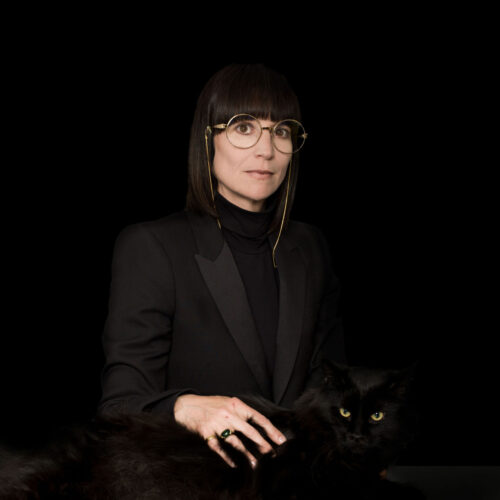
Tina Winkhaus creates visual worlds in which beauty forms a seductive surface as well as a pathway towards deeper social and psychological tensions. Opulent colours, dramatic lighting and compositions controlled down to the smallest detail draw in the viewer. Gradually, cracks emerge within the visible order: desire and loss, power and vulnerability, abundance and decay unfold as closely interconnected forces.
Biography and Artistic Practice
Tina Winkhaus was born in Essen in 1966. From 1987 to 1989, she studied at the Bayerische Staatslehranstalt für Photographie in Munich. Years of study and work in New York and London followed. She has lived and worked in Berlin since 1999.
Photography forms the foundation of her work. Winkhaus expanded its documentary possibilities at an early stage and developed a process in which visible reality becomes the source material for an extensive pictorial construction. She photographs people, animals, plants, interiors, fabrics and objects individually before bringing them together digitally. A new scene emerges from numerous layers, with light, perspective and spatial relationships precisely coordinated.
This elaborate process brings her work close to painterly composition while retaining the photographic origins of its individual elements. Winkhaus treats light, bodies and space with an attentiveness that recalls the pictorial dramaturgy of Renaissance and Baroque painting. Her large-scale works can therefore be read as photographic tableaux: constructed spaces in which every gesture, surface and object serves a particular function within the composition as a whole.
Art History and the Present
Tina Winkhaus’s work is deeply rooted in the visual memory of European art history. Caravaggio, Goya, Zurbarán and Rembrandt, Dutch still-life painting and the Baroque vanitas resonate within her visual language alongside Surrealism, cinema, fashion, popular culture and contemporary forms of mediated self-presentation.
A deep, almost velvety black frequently provides the spatial and atmospheric ground of her works. Figures and objects emerge from this darkness through concentrated lighting. The resulting chiaroscuro lends the scenes a solemn presence that gradually reveals itself as fragile and contradictory.
Winkhaus is particularly interested in images through which societies communicate ideas of beauty, success, femininity, childhood, status and belonging. Her figures embody such expectations while retaining a distinct and psychologically charged presence of their own. The body becomes a visible surface for cultural projections. Luxury can convey seduction, protection, abundance and social distinction in varying degrees.
The artist examines these forms of self-presentation with analytical precision and an often dark sense of humour. Her scenes retain the allure of their motifs while making their underlying conditions perceptible. Their intensity arises precisely from this coexistence of sensual presence and subtle unease.
Hope, Sorrow and Eternal Sadness
In series such as Hope, Sorrow and Eternal Sadness, Winkhaus explores the cracks within seemingly perfect façades. Children and young women appear in carefully staged scenes whose beauty is accompanied by an elusive sense of disquiet. Expectations, projections and socially constructed roles condense into situations that seem familiar yet resist any single explanation.
The figures are presented without exposure or moral judgement. Winkhaus instead reveals the close interrelationship between self-image and the gaze of others, seduction and control, and the desire to belong.
Unter Tage: Shot by God
The series Unter Tage: Shot by God leads into a labyrinthine world of mine shafts and hidden chambers. Across fourteen large-scale works, enigmatic figures emerge whose actions hover between ritual, desire, disorientation and threat.
The interior of the mine becomes a concentrated psychological and social space. What appears ordered above ground assumes a physical, unrestrained and at times unsettling form below. Personal memory, industrial history and archetypal ideas of descent converge in a multilayered narrative.
Earth Odyssee
In Earth Odyssee, apes assume human roles. Dressed in splendid garments, they ride horses, play cards and move through landscapes in which human civilisation survives as a damaged backdrop.
Winkhaus draws upon the art-historical tradition of singerie, in which apes imitate human behaviour and reflect social structures. In her works, they become ambivalent representatives of humanity in the Anthropocene: survivors, rulers, players and fools inhabiting a world whose foundations have already begun to fracture.
Some of their sumptuous-looking garments are made from dyed plastic materials. Aesthetic seduction and ecological danger are thereby joined in a direct material relationship. The gleaming surface already contains the traces of the civilisation whose future the images bring into question.
Natura Morte
In the series Natura Morte, Winkhaus carries the tradition of Baroque still-life painting into a contemporary visual language. Animals, plants, fruit and architectural fragments emerge from deep darkness. Parrots, pelicans and other creatures possess an almost psychological presence. The light accentuates and isolates them, lending them a quiet sense of drama.
The animals expand the inherited iconographic vocabulary of the still life. They appear less as decorative or readily decipherable symbols than as autonomous protagonists within the composition. Beauty and menace, control and autonomy, life and transience enter into a delicate balance.
Winkhaus transfers central concerns of painting into a digitally constructed photographic form: the organisation of space, the modelling of light and the symbolic charge of objects. Vanitas acquires a contemporary dimension. Transience now also points towards a world in which nature is threatened, fragmented and increasingly perceived as an image, a resource or an artificially preserved archive.
Space and Staging
Winkhaus repeatedly extends her artistic practice beyond the individual image. For Your Reality Is Not Mine, presented during Berlin Art Week at BIKINI BERLIN in 2018, she created an entirely mirrored room in which photography, video, architecture and the visitors themselves merged. Through their reflections, visitors became part of the visual order.
Further presentations, including Perfection under Construction at KPM Hotel & Residences and Unlocking the Unknown at LIVING BERLIN, demonstrate her interest in immersive environments where art, space, design and social encounter converge.
A current manifestation of this approach is the Château de Winkhaus, an imaginary world developed by the artist in which artwork, space, fashion, luxury and identity are brought together within a comprehensive visual system. The Château can be understood as an artistic persona, a fictional architecture and a shifting stage for different bodies of work. It thus continues a central theme running throughout her practice: the exploration of spaces in which people present and transform themselves and create social realities through images.
Analogue AI
Tina Winkhaus uses the term “Analogue AI” to describe her particular form of image-making. The phrase refers neither to a technical method nor to the use of generative artificial intelligence. It serves as a metaphor for a complex creative process guided entirely by a human mind.
Experience, memory, intuition and an extensive personal image archive interact within this process. Winkhaus photographs the components of her works herself, edits them digitally and brings them together through a lengthy and meticulous procedure. Every selection, alteration and compositional decision remains under her control.
The precision and multilayered construction of the resulting images may recall artificially generated visual worlds. Their creation, however, is grounded in photographic material, technical craftsmanship and the artist’s conscious direction. “Analogue AI” therefore also draws attention to the capacities inherent in human perception, memory and imagination.
Since the 1990s, Tina Winkhaus’s work has been presented in numerous solo and group exhibitions in Germany and internationally. Her works have been shown in Berlin, Munich, Barcelona and New York, among other cities, and have appeared at art fairs. They are held in private and institutional collections, including the collection of Landesbank Baden-Württemberg.
At the heart of her work lies the question of how images generate reality and shape our perception. Winkhaus responds with scenes that appear splendid and damaged, familiar and strange, serious and infused with dark humour. Her works seduce the eye before gradually leading it towards the contradictions that continue to operate beneath the visible surface.