
Andrea Damp
GLIMMER
August 28 – October 17, 2026
opening reception: August 28, 6 – 8pm
Berlin Art Week opening hours: 11 Sept. 12:00–20:00 / 12 Sept. 12:00–20:00 / 13 Sept. 12:00–18:00
Paintings of the exhibition Glimmer here

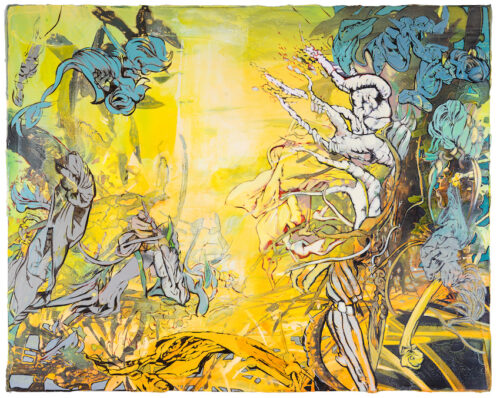
Andrea Damp’s solo exhibition GLIMMER at janinebeangallery Berlin brings large-scale paintings from 2015 to 2017 into dialogue with new works from 2026. Around ten years separate the two groups of works. Yet the exhibition does not present a linear development from an earlier period toward a supposedly more accomplished one. Instead, it reveals how consistently Damp continues to pursue fundamental questions within her painting.
How long can a painting remain open? At what point does color condense into space, landscape, or figure? And how does memory alter what we think we recognize?
Two Bodies of Work in Dialogue
In the earlier paintings, plant-like forms, fragments of bodies, animals, and suggestions of space combine to form a dense painterly structure. The new works revisit this tension between figuration and freer forms while shifting the balance between them.
Damp uses narrative cues more sparingly. Color, surface, rhythm, and spatial movement gain greater autonomy. As a result, the paintings appear both precise and difficult to define. Something emerges, remains visible for a moment, and then resists unequivocal identification.
Painting as an Open Process
“The spaces and the color palette are resolved as late as possible,” Andrea Damp says of her working process.
There is no predetermined story at the beginning that is subsequently illustrated. Damp develops her paintings through an open process of color, line, surface, structure, and contrast. Fluid and transparent layers of paint encounter denser passages. Forms are reworked, concealed, or revealed again.
Only during the process of painting does it become clear which elements will remain. For a long time, it is equally uncertain whether they will develop into a landscape, a figure, or the suggestion of a scene.
Figuration and abstraction are therefore not opposites. They belong to the same process of finding the image.
Selected Works from the Exhibition
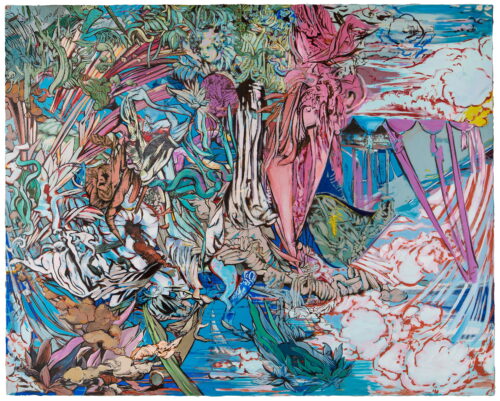
The large-scale painting Das große Welttheater from 2015 demonstrates this principle with particular intensity. Plant-like structures, fragments of bodies, linear movements, and fields of color overlap within a composition that has no fixed center.
Its culturally and historically charged title evokes the long-standing idea of the world as a stage. Damp, however, does not construct an orderly spectacle with clearly assigned roles. Her world theater appears instead as an almost impossible simultaneity in which nature, body, space, and painting continually enter into new relationships.
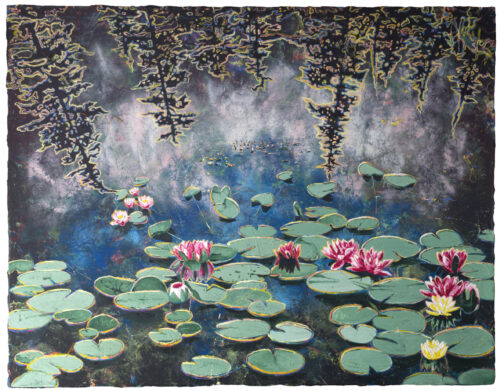
In Wie die Erinnerung es will from 2026, the gaze turns toward a water-lily pond. The motif remains recognizable but never settles into a conventional landscape. Leaves and blossoms rest on a dark surface of water, while black forms outlined in yellow can be read as shoreline, reflection, or vegetation dissolving into abstraction. Near and far begin to overlap.
Memory does not appear here as the reliable preservation of a past view. Instead, it becomes a creative force that selects, intensifies, omits, and reassembles.
The smaller formats condense this interplay further. In Poker Face, a mask-like figure emerges from a dark field of color without revealing its attitude or intention. The Lucky Ones presents two mushroom-like figures that appear simultaneously humorous, vulnerable, and persistent.
Both paintings suggest possible narratives while refusing to resolve them. It is precisely this openness that allows their motifs to retain something beyond any single interpretation.
GLIMMER: Between Material and Sensation
The exhibition title GLIMMER connects the material and emotional experience of the works on view.
Mica, known in German as Glimmer, refers to a group of minerals composed of fine, overlapping layers. Their surfaces change in appearance depending on how the light falls upon them.
Damp’s paintings are likewise created through layers, overpainting, interruptions, and acts of revealing what lies beneath.
At the same time, the English word “glimmer” can describe small moments that unexpectedly evoke joy, calm, or a sense of safety.
In Damp’s paintings, such moments do not appear as untroubled idylls. Instead, they emerge as brief points of light within complex and sometimes dark pictorial worlds: in a blossom, a peculiar figure, an unexpected interplay of colors, or in that difficult-to-explain sense of familiarity a painting can suddenly evoke.
Andrea Damp: Biography and Collections
Andrea Damp was born in Bergen on the island of Rügen in 1977. She initially studied philosophy and art history at Freie Universität Berlin before transferring to the Berlin University of the Arts, where she studied Fine Art under Hans-Jürgen Diehl. In 2005, she completed her studies as his Meisterschülerin.
Her work has been recognized with numerous scholarships and awards. From 2014 to 2017, she taught painting at the University of Applied Sciences in Hamburg.
Damp has presented her work in solo and group exhibitions in Germany and internationally, as well as at numerous international art fairs.
Her works are held in collections including the Art Collection of the German Bundestag, the Willy Brandt House, the Museum für Aktuelle Kunst – Sammlung Hurrle, and Museumsberg Flensburg.
Continuity and Renewal
The earlier and more recent paintings do not explain one another. Instead, they alter the way each is perceived.
A space emerges between them in which continuity and renewal, memory and the present, figuration and free painterly form encounter one anothe