

Between Myth and Identity
Hybrid creatures have accompanied art since its earliest beginnings. Combining human and animal forms, they challenge fixed ideas of identity and the boundaries between nature, culture, and imagination. One of the oldest known examples is the Lion Man from the Ice Age, carved from mammoth ivory around 40,000 years ago, already suggesting a world in which humans, animals, and the supernatural coexist.
Throughout history, hybrid beings have appeared in cultures across the world. From the Egyptian Sphinx and the centaurs and sirens of Greek mythology to medieval manuscripts filled with fantastical creatures, they have symbolized transformation, wisdom, mystery, danger, and the unknown. Rather than existing as monsters alone, they often occupied the space between opposing worlds: civilization and wilderness, life and death, reason and instinct.
Modern and contemporary artists have reinterpreted these figures in new ways. No longer tied solely to mythology or religion, hybrid forms became a means of exploring identity, memory, psychology, and humanity’s relationship with the natural world. Artists such as Pablo Picasso, Francis Bacon, and Wifredo Lam used hybrid bodies to question the stability of the human figure and the complexity of cultural experience.
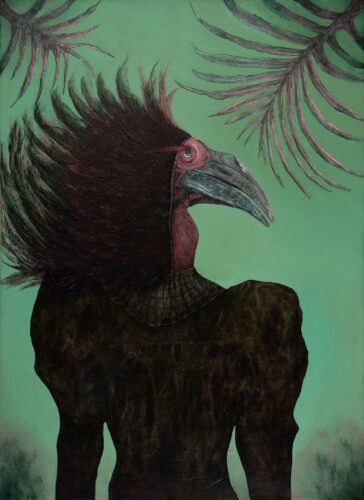
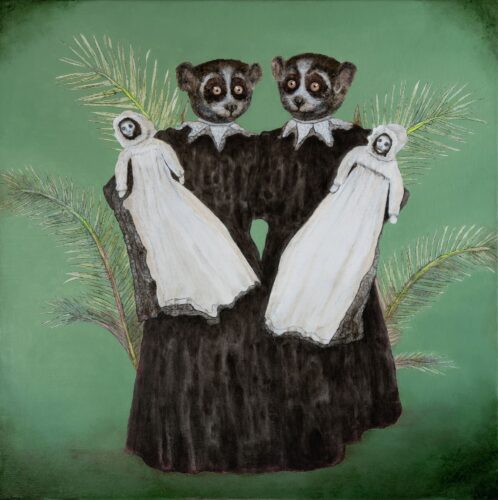
Marie Louise Elshout continues this long artistic tradition while giving it a distinctly contemporary voice. Her paintings combine historical costumes with animal heads, antlers, beaks, ears, and other nonhuman features. Yet her figures are neither mythical monsters nor illustrations of folklore. Instead, they possess dignity, individuality, and a striking psychological presence.
Like traditional portraits, Elshout’s figures confront the viewer calmly and directly. By combining familiar portrait conventions with hybrid bodies, she gently dissolves the boundaries between human and animal, past and present, reality and imagination. Her paintings suggest that identity is never fixed, but always in a state of transformation.
In Elshout’s work, hybridity is not a symbol of otherness or fear. It becomes an expression of openness, change, and coexistence. Her creatures stand between portrait and myth, memory and invention, inviting us to see transformation not as loss, but as possibility.
Dee Art Room about Marie Louise Elshout