
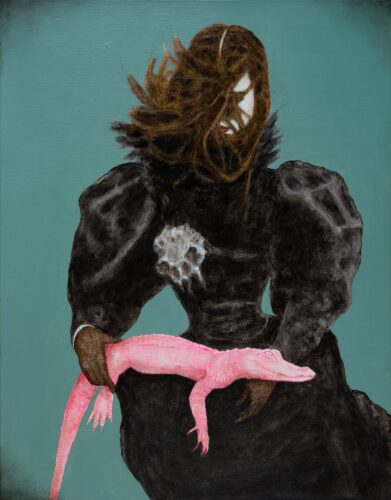
In Vanitas No. 4 (Munich Albino Alligator), Marie Louise Elshout draws upon the story of a white alligator discovered inside a passenger’s suitcase at Munich Airport in 2022. The living animal had been completely wrapped in cling film for illegal transportation and was close to suffocating. In the painting, this real event becomes a contemporary vanitas narrative about humanity’s power over nature: a living creature is removed from its natural environment, concealed, transported and transformed into a valuable commodity.
The darkly dressed figure holds the alligator across her lap. Her pose recalls both a formal portrait and a Pietà—the image of an injured or dead being carried and mourned in someone’s arms. Whether the figure is protecting, possessing or merely presenting the animal remains deliberately unresolved. It is precisely this ambiguity that gives the work its tension.
Her long hair almost entirely conceals her face, withholding any clear identity or emotional response. The figure may therefore appear simultaneously as a guardian, a mourner or the embodiment of the anonymous human power that determines the fate of other living beings.
A pale, skull-like shape emerges on her chest. As a classical memento mori, it points to the proximity of death and suggests how narrow the boundary between a living being, a commodity and a lifeless trophy has become. The luminous pink alligator stands out almost unrealistically against the black dress and cool turquoise background. Its conspicuous colour emphasises its rarity, but also makes it resemble an artificial object or exotic collector’s item. The very quality that makes the animal desirable to humans becomes the source of its vulnerability.
Here, the vanitas theme is not limited to the transience of an individual life. It also encompasses the fleeting nature of ownership and the deceptive value placed upon rarity. What human beings attempt to possess, conceal or preserve may perish through that very act of possession.
The fact that the real alligator was rescued nevertheless introduces a cautious element of hope. The same hands that capture nature can also become hands that protect and preserve it. The painting therefore confronts us with a fundamental choice: whether we regard a living creature as a commodity or recognise it as a being with an intrinsic right to live.