
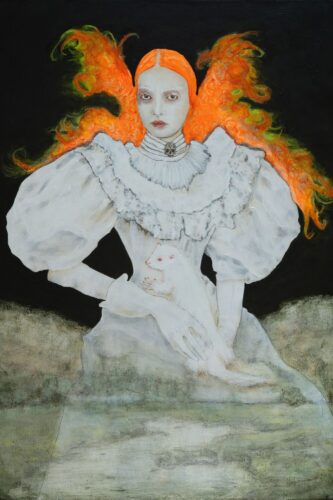
In Vanitas No. 6 (Albino Mink), Marie Louise Elshout brings the traditional vanitas theme into dialogue with questions of memory, nature and human responsibility. The figure wears a historically evocative, almost courtly gown, yet cannot be assigned to any specific period. Her appearance suggests an indeterminate past, while the desire she embodies remains timeless: the human longing for beauty, possession and control over nature.
In her arms, she holds a white American mink, a small carnivorous mammal belonging to the mustelid family. Its unusually pale appearance makes the animal seem both vulnerable and ghostlike. It can be understood as representing the generations of mink bred and kept on fur farms. The animal’s whiteness in particular highlights the troubling tension between apparent purity, precious luxury and concealed suffering.
At the lower edge of the painting, transparent glazes create the impression of an indistinct landscape fading into mist. It appears less as a specific place than as a vanishing memory: a vision of nature that eludes human control and whose traces are gradually disappearing.
The woman’s vivid, flame like hair forms a striking contrast with her pale face, white gown and the equally white animal. Between illumination and extinction, present and past, the painting develops a contemporary form of Memento mori. It reflects not only on the transience of human life and outward beauty, but also on the fragility of nature and our responsibility towards the living creatures that humans have subjected to the pursuit of luxury and status.